In my career and life, I have had the opportunity to learn many things, from cutting my own hair during Covid (I shed a few tears) to building websites and web applications (I shed even more tears). Growing up, I used to think that only people with multiple years of experience were qualified to solve problems for specific projects. After working in a few start-ups and small businesses and being exposed to some fantastic mentors, I discovered that the best of us learn new things and make decisions as we go.
My quick learning method does not negate the need for further collaboration in finding solutions with experts. However, to gain confidence to have meaningful initial discussions for brainstorming, one needs to have a basic understanding of the topic or domain at hand. For instance, learning how to use a thinning shear has empowered me to effectively communicate my preferences when asking for layers at the hair salon, ensuring that I no longer end up looking like I have been electrocuted on humid days.

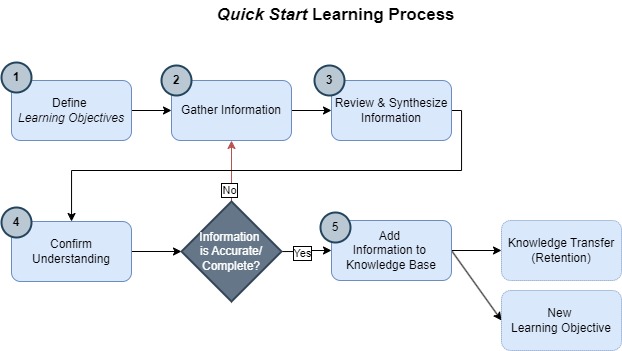
Below is a high-level process I use to quickly start learning when tackling new projects, topics, or domains. This process can also be applied to personal learning. The timeline for each step varies depending on the project’s complexity, deadlines, and learning objectives.
Quick Start Learning Process
| # | Step Task | Description |
| 1 | Define Learning Objectives | This is the crucial first step in maintaining focus on your learning journey. Ensure you clearly define why you are learning and the goal or question the information will be used for. |
| 2 | Gather Information | Gather as much information as you can to support your goal/question from a variety of sources: -Interviews from Subject Matter Experts -Free/Paid Webinars -Free/Paid Educational Resources -Regulatory Websites/Forums |
| 3 | Review & Synthesize Information | Take all the information you’ve gathered and ensure that it: -Is relevant to the goal/question -Comes from reputable sources Use multiple techniques to ensure you understand the data (concepts/techniques/process) you’ve collected. Some modelling techniques you can use are: -Mind Maps -Concept Maps -Context Diagrams (for systems) -Stakeholder Analysis -Functional Decomposition |
| 4 | Confirm Understanding | Work with your sources from Step 2 to validate your understanding and clear up any contradicting concepts. This step might take you back a few revisions to collecting more data and adjusting your gathered information. Sometimes, this step may have constraints if you need access to subject matter experts. *Remember, the ultimate goal is to ensure that the information you gather is not only accurate but also complete, meeting the learning objectives of your research. |
| 5 | Add Information to Knowledge Base | Your current knowledge base may be updated as new information is discovered in future learning objectives. Once you have the initial version of your knowledge base, you can choose to do one or more of the following: A. Start a new learning project to delve deeper into subtopics. B. Share the knowledge to help develop a deeper understanding of the content. C. Work towards mastering the skills and concepts. |
What is your approach to learning new things, and do you have any tips for each step? Feel free to message or comment!
 QWERTY BLAH
Leave a comment