In recent years, I’ve come to a crucial realization: I no longer enjoyed my life. I was on the brink of burning out and always chasing the clock, trying to balance a full-time job, personal life, self-improvement, and studies. This realization hit me at the worst possible time, amidst a whirlwind of projects and deadlines with constantly shifting expectations. Despite this, I struggled with setting boundaries. Growing up as the oldest in my family, saying ‘no’ felt like a death sentence. It meant risking the dismissal of all my past contributions and successes and being labeled as ‘selfish’. So, like a coward people-pleaser, I ended up saying ‘yes’ to everything.
After reviewing my to-do list and future plans, I realized that most of them didn’t align with my own goals or values. My ME project had too many items in the backlog that needed to be re-prioritized or removed. Since then, I’ve been working to overcome this guilt and my need for validation, as well as my continuous need for feeling accomplished, by applying management and prioritization techniques that I use in my career to refine my personal backlog. I know what you’re thinking… It’s ironic that I’ve used work methods to get my personal life in order. But sometimes, the solutions we seek are closer than we think, even if they come from unexpected places.
Here’s a quick breakdown of my survival prioritization method:
Shifted Mindset
I embraced 2 guiding principles:
- Some results won’t satisfy everyone. In my situation, the most crucial person to consider was MYSELF.
- Saying “no” signifies saying “yes” to other opportunities. Your “project” is your life and remaining open to things that genuinely bring you joy is essential.
Applying Agile to My Personal Prioritization Goals
Disclaimer: I want to emphasize that while I am using Agile methodology and frameworks (Scrum) for personal projects, it may not perfectly align with how I recommend its use in a professional setting. However, I am integrating key Agile principles, such as prioritizing adaptability over rigid planning and valuing individual interactions over strict processes and tools, to enhance the effectiveness of my personal projects.
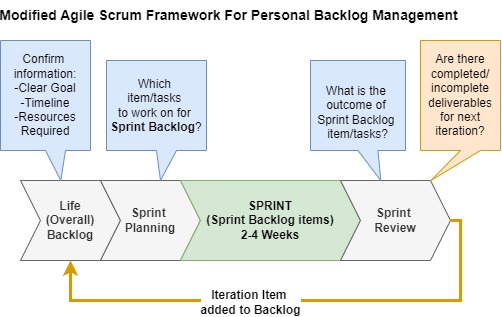
Backlogs: I use an overall backlog to maintain a list of projects (personal/collaborations). For example, installing the new faucet, obtaining PDU hours.
Sprint Planning: My partner and I, as a team, review the overall backlog list and decide which tasks to focus on for the next sprint and how they will be completed for current sprint (Sprint Backlog).
Sprints: I work in 2-4 week time periods to complete items in the sprint backlog list. This structured approach not only helps me manage my tasks but also gives me a sense of progress and achievement as I complete tasks within the set time frame.
Sprint Review & Iterations: After completing tasks for each Sprint, I review the outcome and use that information to plan for the next sprint. If the deliverables do not meet the standards set in the Sprint Planning, I add them back into the overall backlog as a new item. For example, if I finished setting up a new fish tank in Sprint 1 but I am not happy with the plant arrangement, I will plan to rearrange the plants in the following sprint if there is time. It’s important to remember that it’s okay not to be perfect the first time.
Incremental Delivery: Each deliverable must be complete in its own way. I break up large projects, such as house maintenance, into smaller mini-projects that are delivered in multiple sprints. For example, for a large project like renovating the bathroom, you can break it up into smaller projects like Sprint 1: Installing a new tub, Sprint 2: Fixing the sink.
Backlog Prioritization
According to Babok (2015), “Prioritization provides a framework for business analysts to facilitate stakeholder decisions and to understand the relative importance of business analysis information.” For my personal use, the main stakeholders are usually myself, the person who is requesting something of me (e.g., my mother requiring computer set-up), or a collaborator (e.g., my partner).
In Babok, prioritization is classified into one of four approaches:
- Grouping – Items classified as high, medium, low priorities, along with consideration with other item attributes.
- Ranking – Ordered from most to least important, usually with sequential values.
- Time boxing/Budgeting – Based on allocation of a fixed resource (time or money).
- Negotiation – Stakeholder consensus on requirements to be prioritized.
I use a combination of Grouping, Negotiation, and Time Boxing/Budgeting since I have an idea of the item priority classification based on its impact, and most of my items have a deadline/resource data. I recommend that you select an approach that fits in with your lifestyle.
Backlog Refinement
I like to revisit my backlog to ensure items:
- Continue to align to my values and goals. If it does not, I remove it or lower its priority.
- The information about the goal, timeline, and people needed is clear. If a goal is too large, I tend to break it up into smaller goals to gain a better understanding of resources required.
My approach isn’t perfect and continues to develop as I navigate through life, but I hope it provides some insights for you to apply in your life if you are facing similar challenges.
What strategies or advice do you have for personal prioritization?
 QWERTY BLAH
Leave a comment